Monday, September 3, 2018

audacious, authentic and inspirational

While traveling recently, I read Yes We Still Can by Dan Pfeiffer, senior advisor to President Barack Obama.


Since Donald Trump was inaugurated I have been on an emotional and physical roller coaster ride. From the rolling back of environmental regulations to the separation of immigrant families at the border, the litany of outrages has caused anger, cynicism, and sadness. This book is a road map to the future, an attempt “to better understand the current state of politics and look at where we go from here.”

Some of my favorite parts:


"Mr. President... you've talked a lot about how we're all trying to get our paragraph right in history. What do you hope that paragraph says about you?"The president replied, "When I think about what will most  gratify me, it will be if, twenty years from now, I can look back and I can say, wow, look at all these people who first got involved - maybe even when they were too young to vote - in government, politics, issues, nonprofits, public service, and that wave just kind of - a cleansing wave just washes over the country. And if that happens, then the details of how we dealt with climate change, or whether the individual responsibility on the Affordable Care Act was the right approach or not - that becomes less important. Because if we're getting the broad direction right, this is a pretty ingenious country, full of ingenious people, and we'll figure it out. And that's what I want - is I want everybody to feel like we can figure this out if we just don't waste a lot of time doing dumb stuff."


Obama made the case that the campaign was worth running because he had something to say that he felt was with saying. 
At the end of the conversation, Obama looked me right in the eye and asked, "How often do you get to put your shoulder against the wheel of history and push?"


At the 2016 Democratic Convention, Michelle Obama described the Democrats' response to Trump's infantile antics and vulgar insults as "when they go low, we go high." In the end, the side that went "low" won the election and a debate ensued in the Democratic Party about whether going "high" was the right response to Trump.


Trump is a symptom of the plague that has infected the GOP, but he is not the disease itself. Trump didn't take over the party; he is the end result of a party that weaponized  racial anxiety to motivate their base during the Obama era. The good news is that this is not a sustainable strategy in a country that is getting more diverse by the minute.

And finally... the final lines:


Obama knew what I was asking, and he sighed and shook his head and said, "Look, this isn't an ideal situation to say the least," and then we both laughed. Then he said, "Maybe I'm just looking for a silver lining, but I am hopeful that this will be the clarifying event that will show the public the two different visions for the country." 
And there it was; the eternal optimism and unending faith in the American people. 
I am going to miss him.We are going to miss him.

 In the end, Pfeiffer advocates that America take the high ground. “Hate worked for Trump; it won’t work for us,” he writes. “It requires being audacious, authentic and inspirational.” 

Here's to the 2018 midterms.

May we be audacious, authentic and inspirational!

Saturday, September 1, 2018

harnessing individuality

Last month I read the book The End Of Average: Unlocking Our Potential By Embracing What Makes Us Different by Todd Rose.


The book begins with the following story...


Jet Cockpits and The End of Average from Future for Learning on Vimeo.

The Air Force realized performance results for pilots were improved when they stopped designing for "average" but made jet cockpits adjustable. It's a story of how a clear and pragmatic change can have big results. Todd Rose - author of "The End of Average" - uses the story to wonder and provoke how human potential can be unlocked in the U.S. by considering how schools can be re-designed and updated for the future.


Institutions, like education, operate under the misguided belief that statistical averages are a good way to measure individuals. Excellence, too often, is not prioritized over conforming to the system.  Author, Todd Rose, draws on the latest research to show how, when we focus on individual findings rather than group findings or averages, we can rethink the world and everyone’s potential in it.

The End Of Average reminds us that we are not anything close to average.  Average is a statistical myth. The question that drives this book is "How can a society predicated on the average ever create the conditions for understanding and harnessing individuality?"

Check out more about Todd Rose and his desire to change society one student at a time in this video:


"The ideal that we call the American dream is one we all share - the dream of becoming the best we can be, on our own terms, of living a life of excellence, as we define it." -Todd Rose

Finally, check out Todd's TEDx talk...

Friday, August 17, 2018

do not be overcome


Two of the books I read while on vacation were: 1947 Where Now Begins by Swedish journalist Elisabeth Åsbrink and On Tyranny Twenty Lessons From The Twentieth Century by Timothy Snyder. Both were extremely informative and enlightening.

1947 may be one of my new all-time favorite books. I think absolutely everyone should read it. The book examines the events of 1947 and the affect they had on the world we live in today. 1947 came out in Sweden in 2016 and is newly translated into English by Fiona Graham. The book compiles fragmented scenes from across time and space, ordered more or less chronologically. The months of the year serve as chapters, while cities and villages around the world are the characters. There is a sense that the past is never really past, that history has consequences that play out over years... and that history can play out in real time.

For example:


January, 1947, New York 
Now is a time without universal human rights. But has humankind missed something it didn't know existed? Have the world's  religions, seeking to shield that which is human as though it were a fragment of the divine, provided adequate protection? 
The world rises out of greasy human ashes. Here and now, in the United Nations' provisional secretariat in the aircraft factory at Lake Success, universal values are to be established: new thoughts, new premises for humankind, a new morality. A person's rights are not to depend on whether they are Christian or Buddhist, on whether they were born into a family with or without assets, or on their name, sex, position, country of birth, or skin color. 
Entering world history, a 60-year-old woman leads the deliberations. She has just lost her driving license for careless driving. Somewhere beneath the stream of day-to-day political happenings and her sadness at the death of her husband, Franklin D. Roosevelt, somewhere beneath the layer of thoughts about aging, motherhood, and the fact that people are unused to a female leader, run the words that will follow the working party from this first day to the last, the same regardless of whether one reads the Confucian philosopher Mencius or the twelfth chapter of Paul's Letter to the Romans: "Do not be overcome by evil, but overcome evil with good." 
Eleanor Roosevelt convenes her first meeting with the working party on January 27. There is a certain euphoria in the air. Never again, say the world's people to each other and themselves. Never again, say the members of the working party charged with creating human rights, who hardly grasp the magnitude of their task.

Get this book for the history buffs you know. Get this book for those who follow politics. 

Get 1947 Where Now Begins and you will surely learn something new.


In On Tyranny: Twenty Lessons From The Twentieth Century, historian Timothy Snyder says "History does not repeat, but does instruct...  If we worry today that the American experiment is threatened by tyranny, we can follow the example of the Founding Fathers and contemplate the history of other democracies and republics."  On Tyranny instructs and illuminates a path forward.  Mr. Snyder provides 20 actionable lessons on preventing, or at least forestalling repression.


Every day we either succumb to or fend off the encroachment of tyranny.

In his book, Mr. Snyder devotes several of the lessons to the power of small decisions in the face of eroding democracy. “The minor choices we make are themselves a kind of vote,” he argues. “Our words and gestures, or their absence, count very much.”

For example: defend American institutions and civil society groups by joining them. Advocate for groups, institutions, and the free press by supporting them financially. “Institutions do not protect themselves.” Also, "beware of loyalty symbols — be it a sticker or armband, or even a hat, I imagine — however innocuous they seem, because they are often used to exclude." 


From 1 to 20, take action daily.


Get this book for those you know who believe in the fierce urgency of now.


Monday, June 25, 2018

books have the power

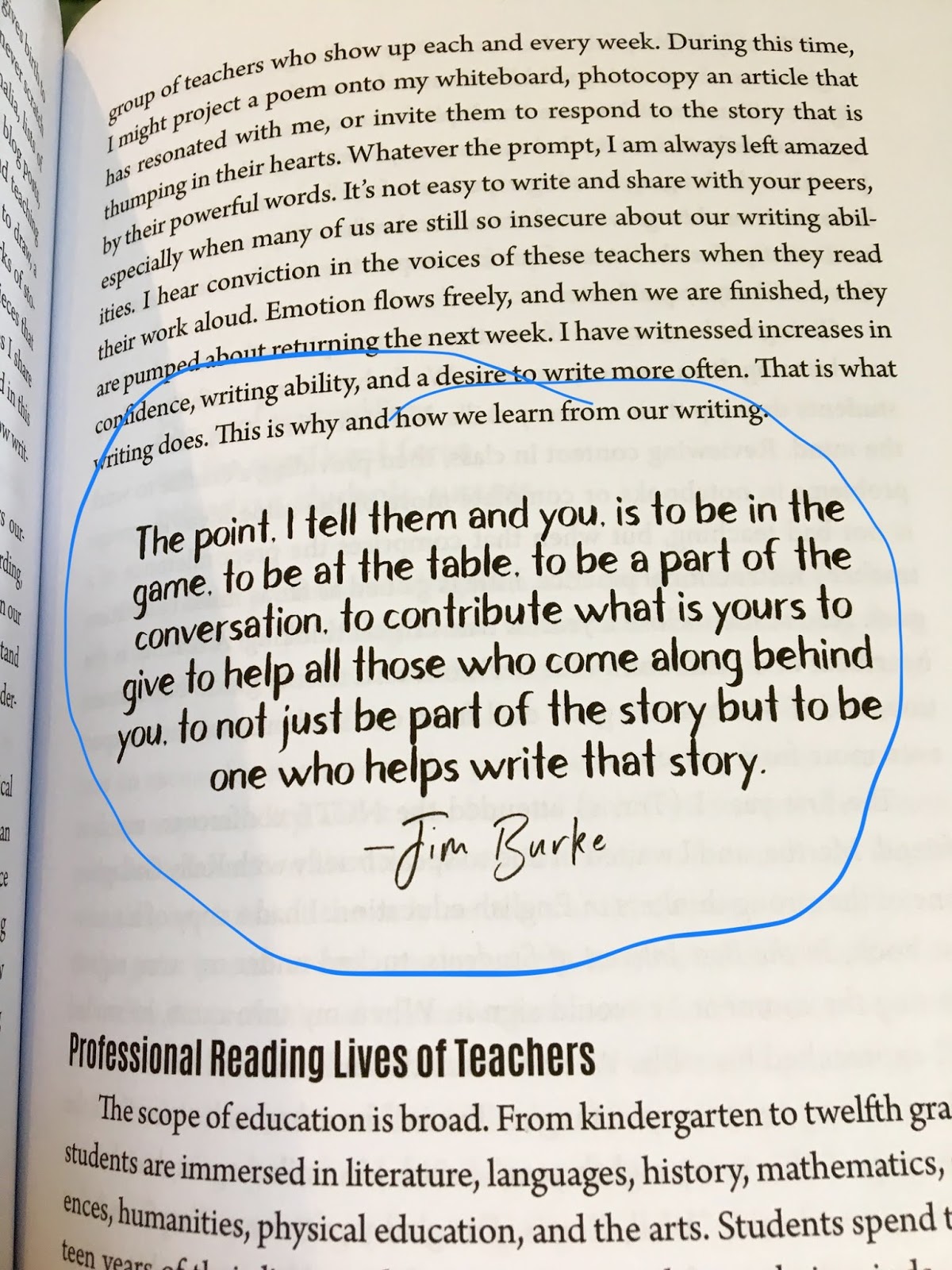
I am reading a great new book - Sparks in the Dark: Lessons, Ideas, and Strategies to Illuminate the Reading and Writing Lives in All of Us by Travis Crowder and Todd Nesloney.


From the back cover:
Books have the power to shape the way we think. Stories--reading them, writing them, and sharing them--give us new lenses through which to view the world and the people we encounter. In short, words matter. 

Some of my favorite quotes:

"We believe this book matters because reading and writing are the foundation of all we do. When you teach someone how to read or how to express themselves using the written word, you change a life."

"When teachers allow students to choose their own books, assignments, and the ways they will demonstrate mastery, it sends a clear message to students that we value their voices." 

"There is an exquisite joy when a self-proclaimed nonreader falls in love with a book."

I love Chapter 7 on Critical Conversations. "Talk is a powerful tool. It is during dialogue that we argue ideas, build new ones, extend our thinking, and grapple with the words and phrases that will enhance an argument."

And Chapter 11, The Noble Heart of a Teacher, is worth reading twice.

Finally, Chapter 13 gives amazing lists of books and resources to inspire your reading and writing life.

I found the Things To Think About and Tweet at the end of each chapter very enlightening.  Check out other readers' thoughts at #SparksInTheDark


Also, Todd and Travis have a Sparks in the Dark Podcast.


Tuesday, June 19, 2018

Keep Families Together


The cruel separation of immigrant families must stop. I urge you to call your representatives and demand that they take action.

Dial 202-224-3121 to call the United States Capitol. 
Press or say 1 to be connected with a senator.
Enter or say your zip code to be connected to your senator.

In Idaho, Senator Crapo's phone lines go directly to voice mail due to the high volume of calls. I left a message saying that I hoped he would vote to pass senate bill 3036, the Keep Families Together Act. Then I left my name and address as I wanted to hear back from him.


You can also sign the petition to pass the Keep Families Together Act.

Sign the petition to the Secretary of Homeland Security: Stop Separating Children From Their Parents.

You can take action with Amnesty International and send a note to congress.

Find out...  How You Can Help Fight Family Separation at the Border from Slate.com  and  How You Can Help Families At The Border from WUSA9

Read @TiffanyBond 's twitter feed where she annotates SB3036 so you can fully understand what's in it.

Take a look at this list of companies that are profiting from the child detention centers. You can contact them.


If you can only read one post, read this:  On Stopping Family Separation from Cup Of Joe


Also READ:

From the Chicago Tribune: A World Without Grace? Stepping Into The Shoes Of Separated Immigrant Families

From the Washington Post:  What Separation From Parents Does To Children: 'The Effect Is Catastrophic'

From ForeignPolicy.org,  George Takei: 'At Least During The Internment...'

From the Washington Post: The Bible In The Hands Of A Bigot

From BuzzFeed News: The U.S. Isn't Just Separating Children From Their Parents. It Also Has No Plan To Reunite Them


Follow: 
#KeepFamiliesTogether
#FamiliesBelongTogether

Go To:
FamiliesBelongTogether.org and join an event near you on June 30th.


Thank You!

Friday, June 8, 2018

I call it education


Last month the City Club of Boise held its inaugural Marilyn Shuler Forum on Human Rights. The speaker for the event was Dr. Les Purce.  Dr. Purce is a third generation Idahoan. His family arrived in Idaho in the early 1900s and he was the first black public official elected in Idaho, serving as a Pocatello city council member and then mayor of Pocatello. In 1989 Dr. Purce became the vice-president at Evergreen State College in Olympia, Washington. By 2000, Dr. Purce was the president at Evergreen, a position he held for the next 15 years. Under his governance, Evergreen State College continued its innovative approaches to interdisciplinary study in the arts and sciences, as well as its commitment to equity, inclusiveness, and social justice.

At the end of the Q and A session of the program, one of the audience members asked Dr. Purce what books we should read to 'help bend the arch of freedom toward justice'. The three books he listed were: Political Tribes by Amy Chua, Grant by Ron Chernow, and Educated by Tara Westover.

I texted my friend, Allison, the book list. She had gone to Evergreen while Dr. Purce was president. She texted back that she had just read Educated and thought it was so wonderful that she picked up a copy for me ("My best friend is a person who will give me a book I have not read." - Abraham Lincoln)!

Listen to the City Club event HERE


I loved Educated by Tara Westover. I have heard this book called an unforgettable memoir - that is difficult to read, but impossible to put down. I agree completely.

From a Powell's bookstore interview:
Describe your latest book. 
I was raised in the mountains of Idaho by a father who opposed many of the institutions that most people take for granted — public education, doctors and hospitals, the government. As a result I was never put in school, never visited a doctor or nurse, and was not given a birth certificate until age nine. I was 17 the first time I set foot in a classroom, but 10 years later I would graduate from Cambridge with a PhD. Educated is the story of how I came by my education. It is also the story of how I lost my family. 

My favorite quotes from the book:
On the highway below, the school bus rolls past without stopping. I am only 7, but I understand that it is this fact more than any other that makes my family different. We don't go to school. Dad worries that the government will force us to go, but it can't because it doesn't know about us. Four of my parents' seven children don't have birth certificates. We have no medical records because we were born at home and have never seen a doctor or nurse. We have no school records because we've never set foot in a classroom.

My life was narrated for me by others. Their voices were forceful, emphatic, absolute. It had never occurred to me that my voice might be as strong as theirs. 

Everything I had worked for, all my years of study, had been to purchase for myself this one privilege: to see and experience more truths than those given to me by my father, and to use those truths to construct my own mind. I had come to believe that the ability to evaluate many ideas, many histories, many points of view, was at the heart of what it means to self-create. If I yielded now, I would lose more than an argument. I would lose custody of my own mind. This was the price I was being asked to pay, I understood that now. What my father wanted to cast from me wasn’t a demon: it was me. 

It’s strange how you give the people you love so much power over you, I had written in my journal. But Shawn had more power over me than I could possibly have imagined. He had defined me to myself, and there’s no greater power than that.

There was a date beneath the image: 1955. I realized that Mother had been four years old in 1955, and with that realization, the distance between me and Emmett Till collapsed. My proximity to this murdered boy could be measured in the lives of people I knew. The calculation was not made with reference to vast historical or geological shifts—the fall of civilizations, the erosion of mountains. It was measured in the wrinkling of human flesh. In the lines on my mother's face.

I began to read—Hume, Rousseau, Smith, Godwin, Wollstonecraft and Mill. I lost myself in the world they had lived in, the problems they had tried to solve. I became obsessed with their ideas about the family—with how a person ought to weigh their special obligations to kin against their obligations to society as a whole


And, from the final page of the book:
You could call this selfhood many things. Transformation. Metamorphosis. Falsity. Betrayal.  
I call it education.

I loved so much about this book and the author.
If you are left wanting more once you finish reading Educated, check out the following:

C-SPAN interview, Tara Westover tells about her life growing up with survivalist parents in Idaho. 
CBS This Morning interview with Tara Westover.
NPR Fresh Air with Dave Davies filling in for Terry Gross.

And here's a quote from The Guardian interview that I didn't want to forget:

You write with the flair of a novelist. How did you learn that?
Everything I wrote at the beginning was awful. Then I became obsessed with the New Yorker fiction podcast.You can hear these wonderful things like Margaret Atwood reading a Mavis Gallant story and then she and Deborah Treisman, the New Yorker fiction editor, will discuss why it works. They’ll bring up all these weird little things that writers do that make it much easier to say – “Yeah, I can do that too”.


Sunday, February 25, 2018

know your rights

Know your rights.

If you're planning to be part of the coordinated student walkouts March 14th and April 20th, know your rights.

If you are a student, a parent, a teacher, school staff, or an ally it's important that everyone learn about their rights.
This Thursday, March 1st at 8pm ET, the ACLU will host a Know Your Rights Training call. Because of the disciplinary threats from certain schools and districts, everyone should learn about students' rights.

Download your own Know Your Rights card.


In addition, know your history: the history of teens organizing for justice.


Here is what I have so far from Larry Ferlazzo:
The Other Student Activists is by Melinda Anderson.


Finally, know what 18 years of gun violence in U.S. schools looks like (from the Washington Post).

Called "Generation Columbine", students currently in high school have never known the U.S. to be a place free from school shootings. The 1999 school shooting at Columbine High School in Littleton, Colorado, took place before today's high school students were born. Today's students have grown up with active shooter drills, locker searches, locked school doors and gates, bulletproof backpacks, and armed officers in their schools. 

It's no wonder students are organizing for change.


Tuesday, February 20, 2018

we call BS

As you know, on February 14th, Valentine's Day, another school shooting occurred at Marjory Stoneman Douglas High School in Parkland, Florida. Seventeen people were killed and fifteen more were taken to area hospitals.

I haven't been able to wrap my head around yet another mass shooting, another school shooting, another weapon of war purchased legally... it's a circle of despair, horror, and anger. But this time there seems to be a spark, the call to action by America's youth, to finally change our collective reality around guns, gun violence, and our assumed right to weapons of war. 

I am not sure what I will do to fan this spark. But I know I can vote; I can march; I can support the young people who are pushing back on NRA funded politicians; I can do so much more than send thoughts and prayers.


We have to elect candidates that are not funded by the NRA this November and beyond. You can register to vote now, as long as you will be 18 by November 6th. Check out vote411.org to find out about voting in your state.

We can support Everytown for Gun Safety, a movement to end gun violence and build safer communities, at everytown.org

We can read Brene Brown's book, Braving The Wilderness, especially chapter four "People Are Hard To Hate Up Close" and "Speak Truth to Bullshit".


We can watch Emma Gonzalez's speech and be inspired:


Monday, February 12, 2018

These will redefine what official portraiture will look like.


This morning, Smithsonian’s National Portrait Gallery unveiled the official, highly anticipated portraits of Barack and Michelle Obama, painted, respectively, by Kehinde Wiley and Amy Sherald. 


The portraits, beyond capturing the first black President and First Lady, represent the first-ever official presidential portraits executed by black painters.

The two portraits will be on view at the National Portrait Gallery beginning tomorrow, Tuesday February 13th. While Kehinde Wiley’s portrait of President Obama will join the institution’s permanent exhibition of presidential portraits, Amy Sherald’s portrait of Michelle Obama will hang in its corridor of recent acquisitions through November 2018. 


Check out this wonderful video of Kehinde Wiley and his art. It contextualizes some of the elements of his portrait of the president.